
 DOC
 Join our Discord
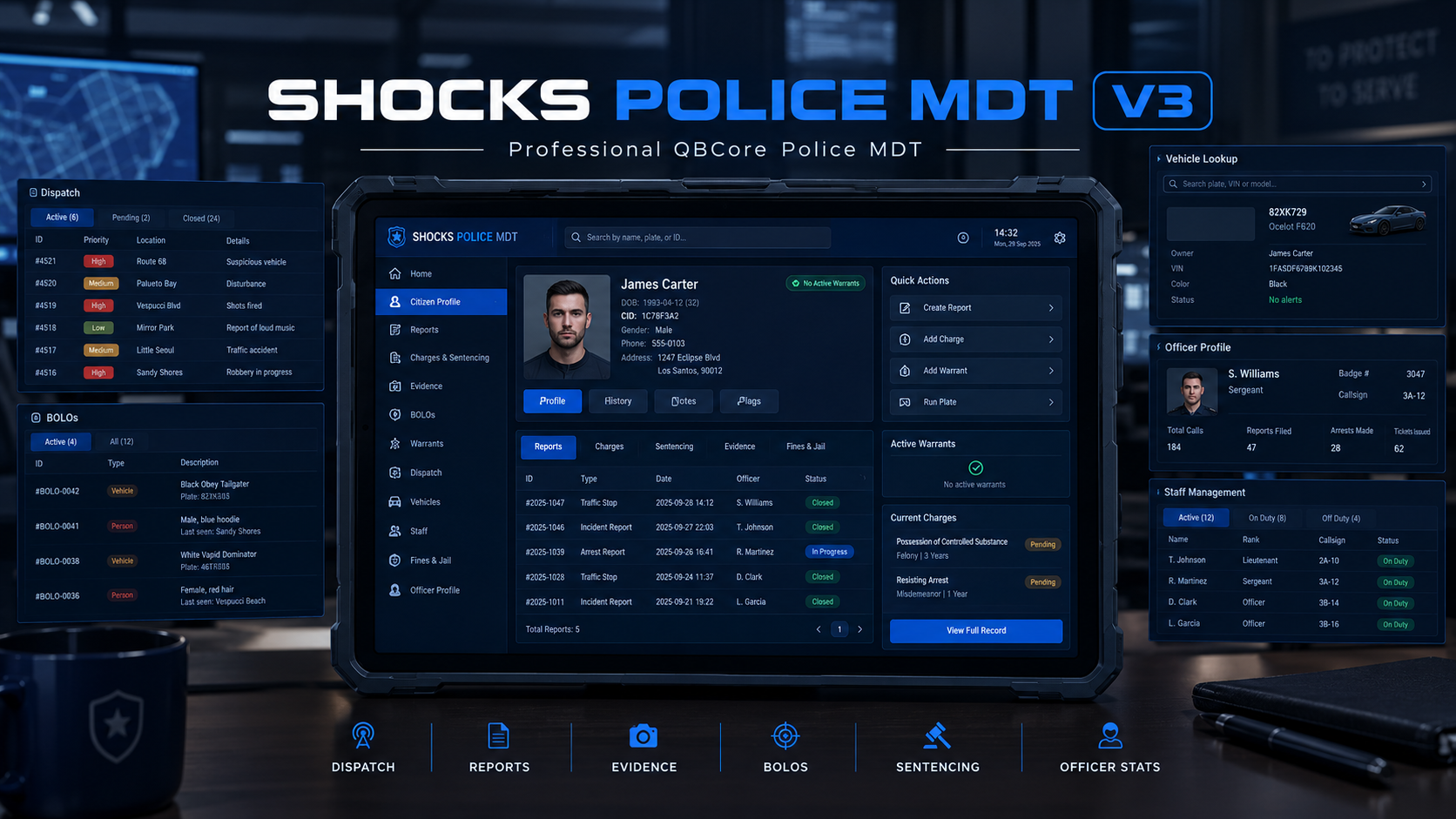
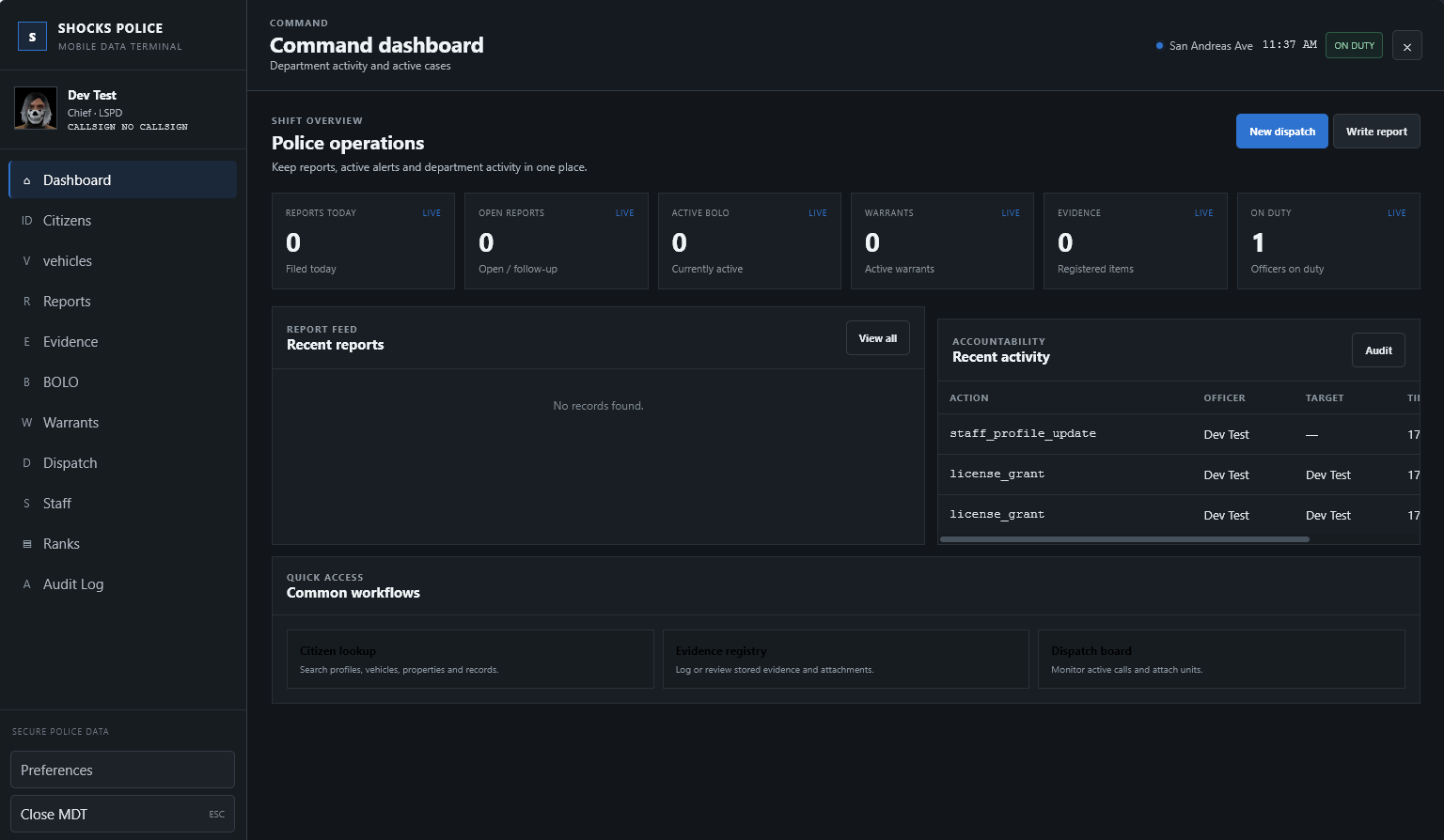

SHOCKS Police MDT V3.5.0
Short Description
A modern, feature-rich Police Mobile Data Terminal (MDT) for FiveM, built exclusively for QBCore. SHOCKS Police MDT V3.5.0 combines advanced citizen records, editable police reports, evidence management, warrants, BOLOs, registered weapons, fishing and business licences, live dispatch, department chat, officer management and detailed performance statistics into one professional, highly configurable interface.
Designed for serious roleplay communities, the SHOCKS Police MDT gives officers and supervisors the tools to search citizens, manage cases, document evidence, register weapons, issue fines and jail sentences, coordinate active calls and manage department personnel. With configurable police departments, permission-based officer management, shared civilian records and evidence, and flexible third-party integrations, V3.5.0 delivers a centralised platform for modern FiveM law enforcement roleplay.
What's New in V3.5.0
Improved Staff Management: Smoother promotions and demotions, improved feedback and more reliable roster updates.
Improved Hiring: Select the correct department and choose from the grades configured for that job.
Expanded Licence Management: Support for fishing licences and business licences alongside existing driver and weapon licences.
Registered Weapons: Record criminally associated weapons against citizen profiles using weapon names, serial numbers and notes.
Editable Reports: Update existing incident reports without unnecessarily repeating associated sentencing actions.
Improved Report Interface: Wider report-writing forms with more space for incident narratives and case information.
Citizen Alerts: View active BOLOs and warrants directly from relevant citizen profiles.
Information Tab: Configure useful departmental links and resources directly through the MDT configuration.
Live Department Chat: Coordinate officers through the MDT dashboard chat.
Multi-Department Support: Configure separate MDT experiences for additional police jobs while retaining shared civilian records, reports and evidence.
Configurable Callsign Management: Control which grades can change callsigns and manage officer profiles.
Interface Polish: Improved navigation, action feedback, readability and staff-management workflows.
Features
Modern Police MDT Interface
A professional tablet-style interface designed for readability, efficient navigation and serious police roleplay.
Clean, modern interface with a blue police-themed design.
Transparent NUI background.
Responsive layout with improved spacing and readability.
Searchable tables and records.
Modal-based citizen profiles and case details.
Wider report-writing interface.
Configurable branding, colours and interface labels.
Tablet-opening animation support.
Configurable command and keybind access.
ESC and close-button support.
Automatic NUI cleanup.
Automatic closing when the player dies or becomes incapacitated.
Police Access and Permissions
Control exactly who can access and manage sensitive police information.
QBCore police job integration.
Multiple configurable police jobs.
Configurable minimum grade requirements.
Separate permissions for sensitive MDT features.
Configurable report, evidence and staff-management permissions.
Configurable officer-profile editing permissions.
Configurable callsign-editing permissions.
Server-side permission and action validation.
Department-specific access and configuration.
Multi-Department MDT System
Build a structured law enforcement environment with separate departmental experiences.
Add additional police-related jobs through configuration.
Configure department names, branding and access.
Assign department-specific MDT settings.
Configure department-specific permissions and chat channels.
Maintain shared civilian records across authorised departments.
Maintain shared police reports and evidence.
Allow authorised departments to access relevant case information without duplicating records.
Configure which grades can manage personnel and officer profiles.
Ideal for servers operating multiple law enforcement agencies, specialist units and separate police departments.
Citizen Search and Profiles
Search citizen records and access relevant information from one location.
Search citizens by:
Citizen ID.
First name.
Last name.
Partial name.
Other configurable identifiers.
Citizen profiles can display:
Character portrait.
Full name and Citizen ID.
Date of birth and nationality.
Phone information.
Fingerprint and blood type.
Employment and current job.
Driver licence status.
Weapon licence status.
Fishing licence status.
Business licence status.
Registered weapon records.
Active warrants.
Active BOLOs linked to the citizen.
Police reports and case history.
Evidence records.
Owned vehicles.
Owned properties.
Other supported police-related history.
Character Profile Pictures
Improve identification and profile presentation with character imagery.
Display available character portraits in citizen profiles.
Use supported character or ped appearance data.
Provide a fallback when a portrait cannot be generated.
Clean up generated headshot resources when the MDT closes.
Licence Management
Manage civilian licences directly through the MDT.
Supported licence categories include:
Driver licences.
Weapon licences.
Fishing licences.
Business licences.
Authorised officers can:
Grant supported licences.
Revoke supported licences.
Review existing licence status.
View licence information on citizen profiles.
Manage licences according to configured permissions.
Fishing and business licence availability can be adapted to your server's roleplay systems and configuration.
Registered Weapon Records
Maintain weapon records against the relevant citizen profile to support criminal investigations and police intelligence.
Weapon records can include:
Weapon name.
Serial number.
Linked citizen.
Additional notes.
Relevant record information.
The system is designed to help officers associate registered weapons with individuals and review weapon information during investigations. Serial numbers should be unique to maintain accurate records.
Police Reports and Case Management
Create, review and edit detailed police reports without losing the connection between a report and its associated records.
Reports can contain:
Case number.
Report title.
Report category.
Report status.
Reporting officer.
Linked citizens.
Linked vehicles.
Charges.
Evidence references.
Incident narrative.
Officer notes.
Attachments and file references.
Created and updated timestamps.
Report management includes:
Creating new reports.
Editing existing reports.
Searching and reviewing case records.
Maintaining links to relevant citizen profiles.
Referencing linked vehicles and evidence.
Tracking report status and case information.
Reports remain persistent and can be accessed by authorised departments using the shared record system.
Advanced Charge System
Find relevant offences quickly through a configurable charge library.
Searchable charge library.
Search by charge name or code.
Search by keywords and aliases.
Category filtering.
Sort by name, fine amount, jail time or points.
Keep selected charges visible.
Add multiple charges to a single case.
Remove charges individually.
Calculate cumulative fines and jail time.
Calculate applicable points.
Review sentencing totals before submission.
Each charge can be configured with:
Charge code.
Charge name.
Description.
Category.
Fine amount.
Jail time.
Points.
Keywords.
Aliases.
Configurable Sentencing
Adapt the sentencing system to your server's rules and legal framework.
Supported sentencing approaches include:
Fine only.
Jail only.
Fine and jail.
Record-only cases.
Configurable fine reductions.
Configurable jail-time reductions.
Sentencing limits and calculation settings.
Full punishment summary before submission.
The MDT calculates the applicable sentence using the selected charges and configured rules.
Officer Performance Profiles
Review recorded officer activity and maintain a more accountable department.
Performance statistics can include:
People jailed.
Total jail sentences.
Total prison time issued.
People fined.
Number of fines issued.
Total money fined.
Reports written.
Evidence logged.
Sentencing cases.
Other supported police activity.
Officer profiles can also contain:
Character portrait.
Rank.
Callsign.
Division.
Commendations.
Disciplinary notes.
Certifications.
Supervisor notes.
Callsign history.
Department activity.
Audit history.
Where supported, activity statistics are recorded through persistent MDT action records rather than relying solely on manually editable counters.
Officer and Staff Management
Manage department personnel directly through the MDT.
Supported actions include:
Hiring officers.
Promoting officers.
Demoting officers.
Terminating officers.
Managing duty status.
Assigning ranks.
Managing callsigns.
Assigning divisions.
Staff-management improvements include:
Improved promotion and demotion workflows.
Better feedback when an action succeeds or fails.
Reduced unnecessary page reloads.
Department selection during hiring.
Grade options based on the selected job's configured hierarchy.
Configurable restrictions on who can manage staff.
Callsign and Officer Profile Permissions
Maintain control over officer records through grade-based permissions.
Configure which grades can edit callsigns.
Allow authorised supervisors to update callsigns through officer profiles.
Control who can edit officer profiles.
Restrict sensitive profile information and management actions.
Configure permissions separately from general MDT access.
This allows servers to give officers normal MDT access while reserving personnel-management functions for supervisors and senior ranks.
Evidence Management
Create and maintain structured evidence records linked to cases and citizens.
Evidence can include:
Evidence number.
Evidence label.
Evidence type.
Case number.
Case description.
Linked citizen.
Linked vehicle.
Storage reference.
Tags.
Chain-of-custody notes.
Image URLs.
File URLs.
Attachments.
Evidence status.
Evidence management can support:
Searching and filtering records.
Viewing detailed evidence information.
Editing and managing records according to permissions.
Reviewing linked cases.
Opening linked citizen records.
Accessing evidence attachments.
Grade-based evidence permissions.
Warrant Management
Create, search and manage persistent police warrants.
Warrant records can contain:
Warrant number.
Subject name.
Citizen ID.
Reason.
Case number.
Priority.
Officer information.
Status.
Creation date.
Resolution date.
Features include:
Warrant creation and management.
Searching existing warrants.
Reviewing active warrants.
Updating warrant status.
Displaying relevant active warrants on citizen profiles.
Permission-controlled access to warrant information.
BOLO Management
Manage persons, vehicles and other subjects of police interest.
Supported BOLO categories include:
Person BOLOs.
Vehicle BOLOs.
Plate BOLOs.
Property BOLOs.
Citizen-linked BOLOs.
BOLO records can contain:
Subject name.
Citizen ID.
Vehicle model.
Registration plate.
Case number.
Description.
Priority.
Expiration.
Active or resolved status.
Officer information.
Officers can search BOLO records, review relevant alerts and use the available resolution workflows. Active citizen-linked BOLOs can be displayed directly on the associated citizen profile.
Live Dispatch
Coordinate active incidents and officer responses through the dedicated dispatch interface.
Dispatch calls can display:
Call code.
Call title.
Description.
Priority.
Location.
Coordinates.
Reporting source.
Assigned officers.
Call age.
Call status.
Officers can:
Attach to calls.
Detach from calls.
Resolve calls.
Set a waypoint.
View active units.
Use configured shortcuts for supported actions.
Police Dispatch Triggers
Support configurable police-style alerts, including:
10-99 Officer Down.
Shots fired.
Officer emergency.
Stolen vehicle alerts.
Custom configured dispatch events.
Third-party resources can be integrated through the configured events, server events, exports or custom handlers available to the relevant integration.
Live Department Chat
Communicate with authorised department members directly from the MDT dashboard.
Live department chat interface.
Database-backed message persistence.
Configurable department channels.
Dedicated LSPD chat configuration.
Automatic message refresh.
Department-oriented communication without leaving the MDT.
Department access should be configured according to your server's job and permission structure.
Information Tab
Provide officers with quick access to important departmental resources.
Add external links through configuration.
Configure link names and destinations.
Display useful departmental information in the MDT.
Link to police procedures, departmental documents, training resources or other permitted web resources.
Tailor the information section to your server's requirements.
Information links can be changed through configuration without redesigning the MDT interface.
Vehicle Lookup
Search vehicle records to support traffic stops and investigations.
Search by:
Registration plate.
Citizen ID.
Vehicle model.
Vehicle profiles can display:
Registration plate.
Vehicle model.
Owner.
Owner Citizen ID.
Vehicle state.
Garage information.
Fuel.
Engine condition.
Body condition.
Vehicle information depends on the configured vehicle database and supported server integrations. Records can link back to the owner's citizen profile.
Property Information
Review supported property information through citizen records.
Supported integration targets include:
qb-houses.
loaf_housing.
Custom property database queries.
Property integrations can be enabled, disabled or adapted through configuration, subject to the database structure of the installed housing resource.
Banking and Billing Integrations
Use an adapter-based integration system to connect police fines to supported financial or billing resources.
Supported integration targets include:
SHOCKS Banking.
SHOCKS Billing.
okok-banking.
Renewed-Banking.
qb-banking.
qb-billing.
okokBilling.
pefcl.
Custom banking or billing integrations.
The selected provider and applicable bridge must be configured for the relevant resource. Availability of individual features depends on the provider's supported API or integration implementation.
Prison and Jail Integrations
Configure the MDT's sentencing system to work with supported prison resources.
Integration targets include:
qb-prison.
rcore_prison.
rs-prison.
pickle_prisons.
Custom prison integrations.
The integration layer can pass supported information such as:
Player ID.
Jail time.
Sentence information.
Officer information.
Case information.
The selected prison resource must be configured and compatible with the relevant bridge.
Audit Logging
Maintain records of important police actions for accountability and investigation.
Audit entries can include:
Officer.
Citizen.
Action.
Case.
Report.
Timestamp.
Relevant action data.
Supported audit activity can include staff changes, report operations, evidence management and sentencing actions. Audit coverage depends on the actions implemented by the MDT and enabled in configuration.
Configuration
SHOCKS Police MDT V3.5.0 is designed to be extensively configurable without requiring unnecessary changes to the core resource.
Configuration options include:
Police jobs and departments.
Minimum grades.
Rank names and grade numbers.
Rank labels and pay values.
Permissions and supervisory access.
Staff-management permissions.
Officer-profile permissions.
Callsign-editing permissions.
Evidence permissions.
Report permissions.
UI branding, colours and labels.
Commands and keybinds.
Report categories and statuses.
Charges, categories and aliases.
Fine values, jail values and points.
Sentencing limits and reductions.
Dispatch codes and priorities.
Dispatch expiry.
Department chat settings.
Information tab links.
Banking and billing providers.
Prison providers.
Property and vehicle providers.
Database queries.
Integration events and exports.
Notification behaviour.
Dependencies
Required
qb-core.
oxmysql.
ox_lib.
Optional
Compatible banking resource.
Compatible billing resource.
Compatible prison resource.
Housing or property resource.
Vehicle or garage resource.
Dispatch resource.
Individual optional integrations require their relevant resources and configuration.
Supported Integration Targets
Banking: SHOCKS Banking, okok-banking, Renewed-Banking and qb-banking.
Billing: SHOCKS Billing, qb-billing, okokBilling, pefcl and custom billing integrations.
Prison / Jail: qb-prison, rcore_prison, rs-prison, pickle_prisons and custom prison integrations.
Property: qb-houses, loaf_housing and custom property database integrations.
Specific integrations depend on the installed resource versions, the available APIs and the configured bridge.
Designed For
SHOCKS Police MDT V3.5.0 is designed for:
Serious QBCore roleplay servers.
Police departments requiring detailed case management.
Communities needing centralised civilian police records.
Servers requiring configurable offences and sentencing.
Departments using officer performance statistics.
Servers operating multiple law enforcement jobs.
Communities requiring shared reports and evidence across authorised departments.
Servers using third-party banking, billing, prison, housing and vehicle resources.
Communities seeking a professional, readable police tablet without excessive visual clutter.
SHOCKS Scripts
A configurable police management system built to support structured law enforcement roleplay, organised casework and multiple departmental workflows.
SHOCKS Police MDT V3.5.0 — One MDT. Connected records. Better police roleplay.